
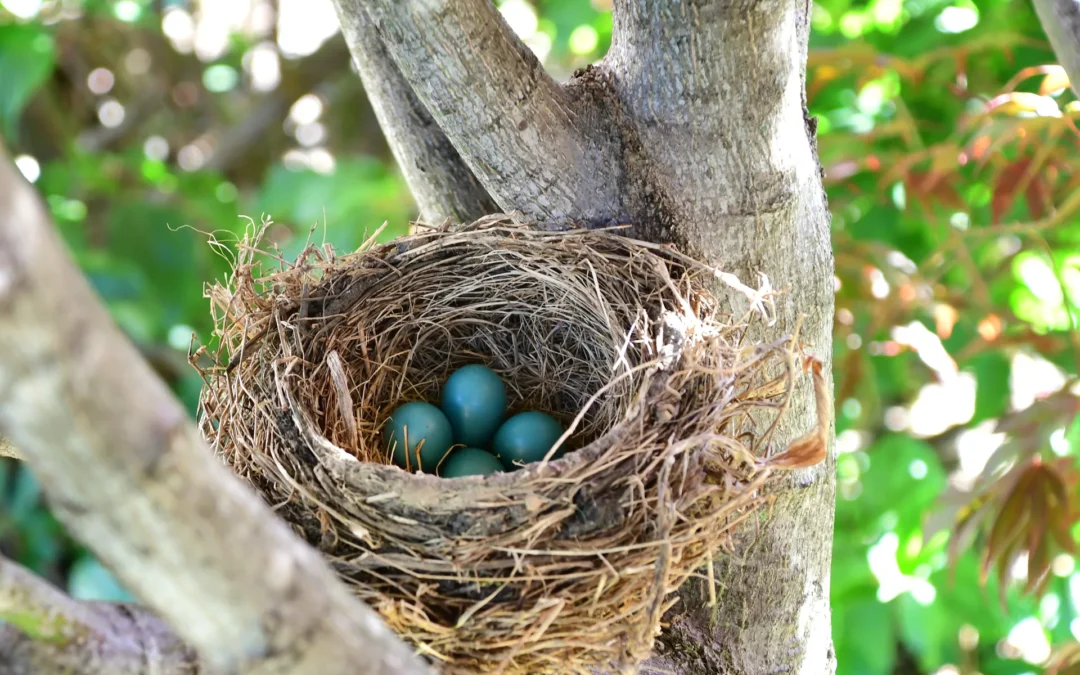
As the days lengthen in late winter, birds start looking for nest sites in our trees, hedges and shrubs. For anyone planning tree work, this changes things. Bird nesting season affects what can be done, when it can be done, and how carefully it needs to be checked.
When is bird nesting season?
In the UK, the main bird nesting season is generally treated as running from March to August, although some birds start earlier and others carry on into September. A mild spell in February can bring the first nests forward, and pigeons and doves can nest in almost any month.
What does the law say?
All wild birds, their nests and their eggs are protected under the Wildlife and Countryside Act 1981. It is an offence to intentionally kill, injure or take a wild bird, or to take, damage or destroy the nest of any wild bird while it is being built or in use. Some species have extra protection, which also makes it an offence to disturb them while they are nesting.
This applies to everyone, including homeowners, gardeners and tree surgeons. Tree work is not banned during nesting season, but the law means that any work must be planned and carried out so that active nests are not damaged or disturbed.
How we plan tree work in nesting season
Checking before we start
Before any pruning, hedge cutting or felling between spring and late summer, we check the tree or hedge carefully for active nests. This includes watching for birds flying in and out, listening for chicks, and looking through the canopy from the ground and, where needed, from the tree.
Changing the plan if we find a nest
If we find an active nest, the work around it stops. Depending on the job, we may leave a section of the tree untouched until the young have fledged, adjust the work to avoid that area, or rebook for later in the year.
Choosing the right time of year
Where there is a choice, we recommend carrying out major work such as heavy reductions, hedge removal and felling between September and February. This avoids the busiest part of the nesting season and is also a good time of year for many trees.
What about dangerous trees?
If a tree is an immediate danger to people or property, it may need to be made safe whatever the time of year. Even then, the work should be limited to what is genuinely necessary, and nests should be avoided wherever possible.
Bats and other wildlife
Birds are not the only wildlife in our trees. Bats roost in cracks, cavities and behind loose bark, and all UK bat species and their roosts are protected by law all year round. Older trees, ivy covered trees and those with holes or splits are the most likely to hold roosts. Part of our job as arborists is to spot these features and plan around them.
Planning ahead
If you know you would like work done on your trees or hedges this year, the best thing to do is get in touch early. Booking a visit in winter gives you the widest choice of dates and lets the work be finished before nesting gets going.
Faithful Tree Care carries out pruning, hedge work and felling across Worcester, Worcestershire and Herefordshire, always with wildlife in mind. You can find out more about our tree surgery services, read about conifer and hedge trimming, or contact us for a quote.

Recent Comments