
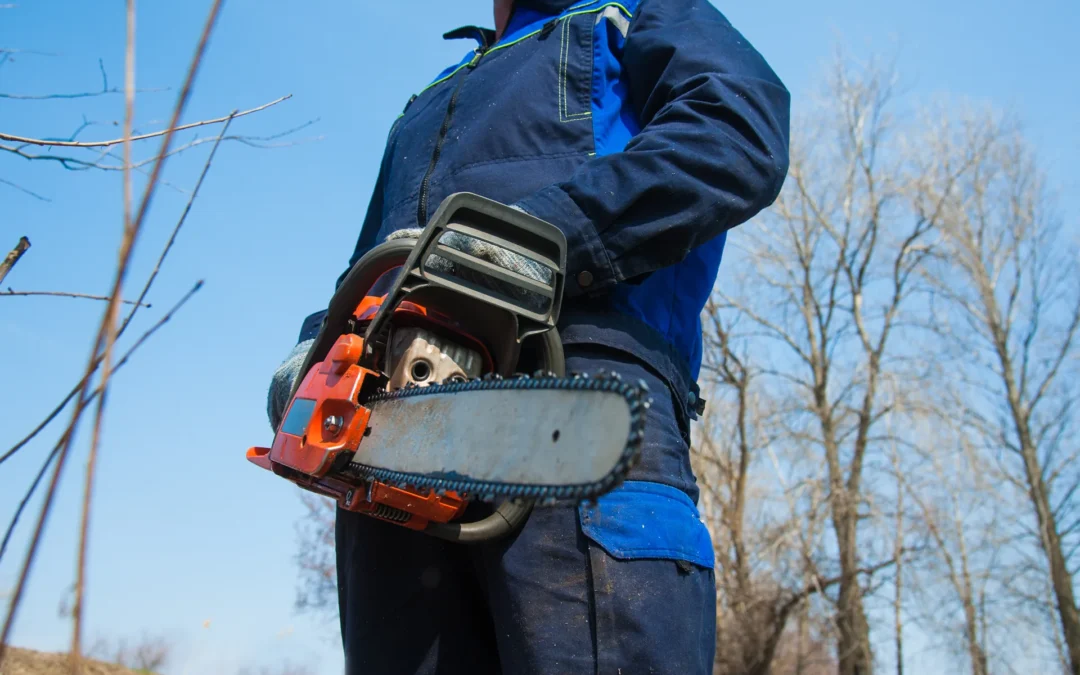
Chainsaws are easy to buy and surprisingly easy to start. That is exactly why they are so dangerous. Every year, people are seriously injured trying to cut down a tree or remove a large branch in their own garden. Here is why chainsaw tree work is best left to trained professionals, and what goes into doing it safely.
Why chainsaws are so dangerous
Kickback
Kickback happens when the tip of the guide bar touches wood or another object and the saw is thrown violently back towards the user, often towards the head and neck. It happens in a fraction of a second. Trained operators know how to hold, position and use the saw to reduce the risk, but no technique removes it completely.
Timber under tension
Branches and trunks are rarely just hanging there. Their weight puts parts of the wood under compression and other parts under tension. Cut in the wrong place, and the timber can split, jump or pinch the saw. This is the cause of many accidents with fallen and storm damaged trees.
Working at height
Using a chainsaw from a ladder is one of the most dangerous things you can do in a garden. Ladders are not stable enough to cope with a moving branch or the kick of a saw. Professional climbers work from ropes and harnesses with a dedicated top handled saw, and they are trained in aerial rescue in case something goes wrong.
The protective kit professionals wear
Health and Safety Executive guidance sets out the personal protective equipment that should be worn for chainsaw work. As a minimum, this includes:
- a safety helmet, with a mesh visor or safety glasses
- ear defenders, as chainsaws are loud enough to damage hearing
- chainsaw protective trousers or leggings, with fibres designed to clog the chain on contact
- protective boots with steel toecaps and cut resistant panels
- suitable gloves and a protective jacket where needed
Protective clothing reduces the severity of an injury. It does not make chainsaw work safe on its own, which is why training matters just as much.
Training and qualifications
Professional tree surgeons in the UK usually hold NPTC City & Guilds or Lantra certificates in chainsaw maintenance, crosscutting, felling and, for climbers, tree climbing and aerial rescue. These cover far more than how to make a cut. They include assessing the tree, planning escape routes, setting up a safe work area and knowing when a job is beyond the equipment available.
Planning a safe job
Before any chainsaw work starts, we look at the whole site: the condition of the tree, which way it leans, where the weight sits, what is underneath, and where people, buildings, cables and roads are. On tight garden sites, branches are often lowered on ropes rather than dropped, and trees are taken down in sections. You can read more in our posts on safe tree removal and tree pruning and reductions.
What you can safely do yourself
Small pruning jobs on young trees and shrubs, such as removing thin, dead or crossing branches you can reach from the ground, can usually be done with good quality hand tools: secateurs, loppers and a pruning saw. If a job needs a chainsaw, a ladder, or involves a branch you cannot comfortably reach and hold, it is time to call a tree surgeon.
Professional tree surgery in Worcestershire
Faithful Tree Care is a qualified and fully insured tree surgery team based in Worcester. We carry out pruning, reductions and felling across Worcestershire and Herefordshire using modern techniques and the right equipment for each job. Call 07828 786300 or get in touch for a quote.

Recent Comments